
Here you are, just learning to sew, or maybe you are returning after having put sewing aside for several years. What do you really need for notions to get yourself started? Well, I don't think you need that much. That big pile of measuring tools you see sheds a pall on my honesty but it's true. I think when starting out on anything new it is wise to get comfortable with a few simple tools and add from there as projects get more complicated and require more complicated tools to help you out. You don't need a ton of notions to start out. Get a few basics and add as your designs require.
We've already discussed threads and needles and pins, so what's next? Let's start with cutting tools. At one time you would be advised what scissors to buy but today there are also cutting options that include rotary cutters and their mandatory mats and rulers. I don't think you need a rotary cutter to start. I firmly believe in laying a foundation and growing from there as time and skills accrue. So start with a good pair of shears. Many moons ago I worked in a fabric store that carried really high quality shears. When the decision was made to discontinue the top of the line models I was able to pick them up at bargain basement prices. My scissor collection boasts TOL scissors by Wiss and Marks and Gingher that are wonderful. But truly, if you look in most scissor drawers, the pair that you see most often, gets the most use, and seems to hold is sharpness interminably are those orange handled shears from Fiskars.
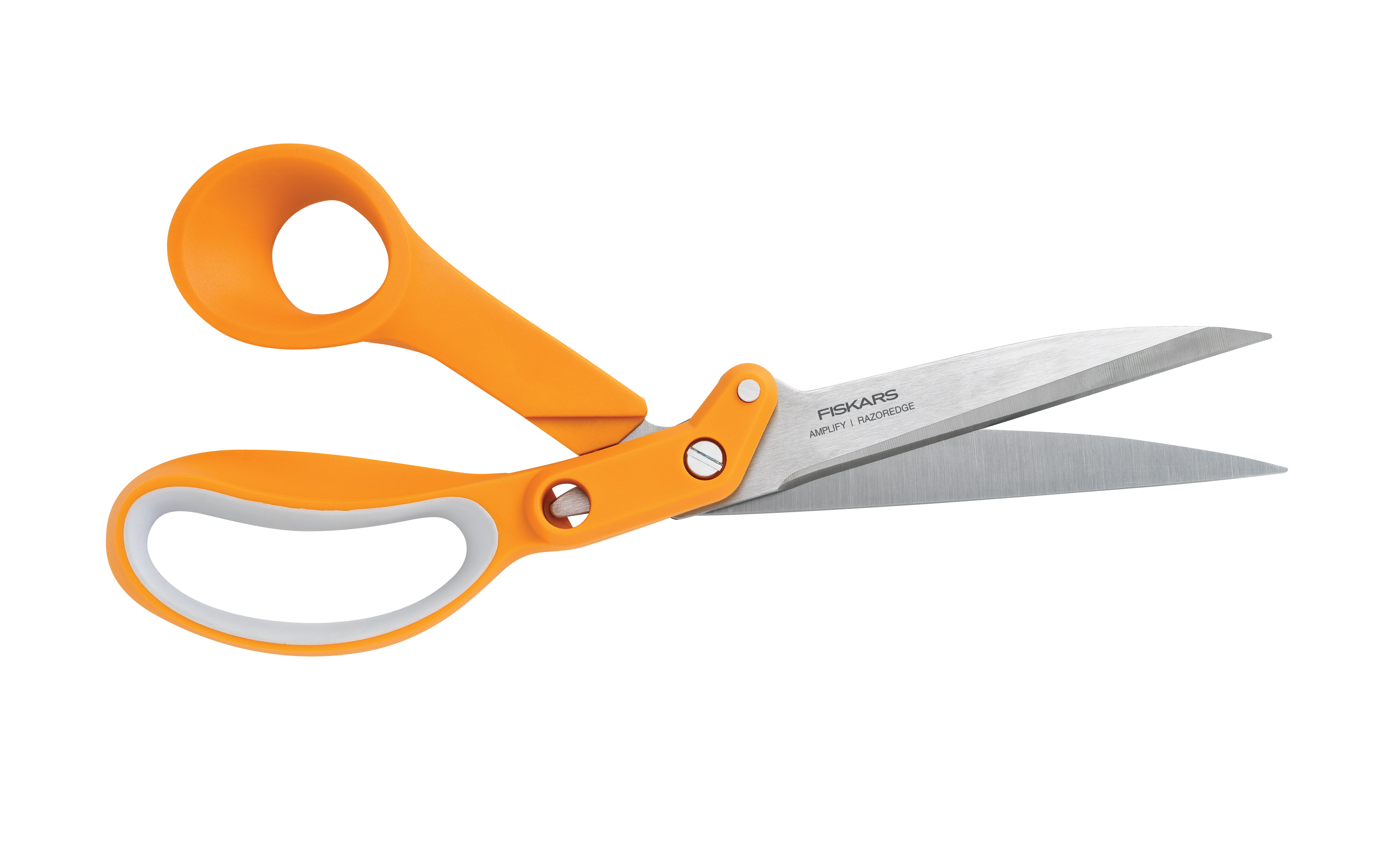
An 8 inch pair won't set you back too much and they will last you a long while between sharpenings. These are basics. They are also lightweight and easy to spot in the notions drawer. If you are going to use your scissors in a class put a wine charm around the handle so you don't lose them to someone who thinks they are their's. Just about everyone has a pair of these in the drawer and they should serve you well. There are lots of other types of scissors but one pair of shears and two other suggestions I have are all you really need. Scissors can run from five inches to ten inches long but the eight inch shears are the most versatile, IMO.
Here are some of the different kinds of scissors that you might like as your sewing skills mature and you start sewing with more challenging fabrics;
Knife edge scissors: These are your basic shears as you see above. They are sometimes designed so the side that your hand goes in, as opposed to your thumb, is in line with the blade. This makes cutting our your fabric easier as the scissors can be held parallel and next to the table while cutting. and therefore not lifting the fabric. Scissors that have the blades centered between the thumb and hand openings tend to lift the fabric as you cut and can easily give you inaccurate cutting despite the best intentions otherwise. Look for the blades set up like you see above in the Fiskars so that one blade can be laid against the cutting surface as you cut. Many scissors come with blade covers which is nice for travelling back and forth to class, safer too! Other manufacturers are are Kai, Marks/Mundail (vintage) and Wiss.

Embroidery scissors: Embroidery Scissors are very sharp usually four inch blade scissors. This is the second pair of scissors of the three I think are must haves for new sewists. These are your life savers. Why? Because they unsew. You will use these time and time again to rip out your sewing mistakes. The sharper and pointier the better as they can slip under the stitches. You have to be careful with these as one slip and it is easy to mistakenly cut your good fabric. It has happened to all of us, you go to cut a buttonhole open and you put a gash across the front of your bodice on a nearly complete garment. Know you are not alone and will get over the pain in time. In the meantime, also know that you need a good pair of sharp embroidery scissors. I have several types but find I really prefer my little Fiskars. Mary Corbet, esteemed embroideress, has a great blogpost on her embroidery scissors and all the different types which you can enjoy here.
Paper Scissors, Kitchen Scissors or any old junk scissors: These can be any type of old scissors that you will relegate to all the scissor chores needed by the rest of the family. Your good scissors - HIDE THEM! Better yet, get some cheapies for the rest of the family. At one time the chains had bins of dollar pairs of scissors. Today we have Dollar stores. I have lots of those dollar scissors hanging around for hubby to use. A good pair of Kitchen Shears is indispensable for heavy duty cutting that your fabric scissors would just faint over. Just know, the third type of must have scissors for any sewist are these, the junk drawer scissors. Make them easily accessible and you will be able to keep your precious sharpsters to your self, well hidden. ; )
Nice but not necessary

Serrated scissors: Above is a pair of Gingher Serrated scissors. Most scissor companies make serrated scissors. Why? They make it much easier and accurate to cut fine difficult fabrics like chiffons, organzas and silks. Those little serrated edges, which you can't see here grab the fabric better and prevent it from slipping away while cutting. Get these when you get to the point of sewing a lot of silks and sheer fabrics. They are nice.

Pelican Billed Scissors: These are also called applique scissors. These are used to cut things that really need extra care. For example, you have done a hem on a chiffon fabric that is first folded up a half inch. Then the folded edge is zigzagged or roll edged in the serger. You now have to cut off that excess piece of chiffon right up to the zigzagged hem without cutting the skirt. These scissors will lift the chiffon and make for safer cutting. These are also great for cutting right up to the edge of machine applique and getting rid of those pokies. The straight leg of the scissor is VERY SHARP AND POINTED. Don't use these to cut threads on the machine. Cutting threads repeatedly in the same spot will dull them over time and they won't work as well. This I personally know. Heirloom sewists use these a lot in their delicate work. These are a bit pricey but watch those coupons and deals from the chains and places like Nancy's Notions.
There are also scissors out there that are more ergonomic and if you are dealing with something like carpal tunnel syndrome, that may be your way to go. They come under names like the Softouch or Comfort Grip . They often don't look like traditional scissors but if they work for you and let you cut without pain, who cares?

Rotary cutters: Frankly, as a brand new garment sewist, I would hold off on the rotary cutter until you have mastered cutting accurate even lines with your scissors when cutting out your patterns. Remember to trim the pattern first before pining it to the fabric and cutting it out. But if you do have some experience under your belt and are ready to handle what can be an extremely dangerous implement, go for it.
Rotary cutters are more expensive. First you need the cutter. I like the smaller size for small curve cutting and the 45 mil size for the rest of my cutting. But you can do it all with the 45 mil cutter with practice. To use the cutter, you need the mat and if you are cutting out garments, you need a BIG mat which will go on a big cutting table. I have used Olfa's, Fiskars, and whatever this plastic thing is that you can pick up at Joanns on sale now and then. I don't know if I bear down too hard. I use only nice sharp blades. But I do a number on cutting mats and you can't imagine how many I have purchased over the years. Right now I am happy with the white plastic type mat from the chains, my second one of it's kind!
Third, you need the rulers. As a newbie, do you need all of these shown above? Not really. Some are leftovers from my long forgotten quilting days. You do need a good straight edge and I love the large 5x24 Olfa ruler that has a lip to sit on the edge of the cutting mat. It really helps keep things lined up while cutting. As you get a little more discerning with your rotary cutter, I would add a Hip curve and a Crotch curve if you can find them. I got mine at a fitting seminar I attended some thirty years ago and I would be lost without them. The crotch curve ruler just nestles perfectly into the curves of , well, crotches, armholes and necklines. A French curve will do similar. The hip curve is used for those longer, smoother curves you find on pants or skirts. I use my triangle ruler a lot too. It is great for establishing lengthen/shorten lines at right angles to the grainline. Do you see how the cost of this rotary business is adding up? Just be forewarned about the expense. It is fine to use scissors and never touch a rotary cutter and be an excellent sewist. Whatever works for you. What works for me is the rotary cutter at this point in time as I like it's speed and accuracy.
Also know that a rotary cutter is a dangerous instrument. I cut off a good hunk of my finger tip and across my nail one time. Never felt a thing. That blade just zipped right through it all and the next thing you know the blood was spouting everywhere. I almost went to the ER, but managed to stick it back together. I have heard some really bad horror stories. I don't think I would use an RC if there were little ones in the house, just too dangerous IMO. I have learned that every single time you run the blade of the cutter down the fabric, you finish that run by immediately closing the blade. Realign things and open the blade again only right before you start cutting. At first it will feel odd and you are opening and closing the blade constantly, but you shouldn't lose a finger. NEVER, EVER leave an opened blade on the table or anywhere, EVEN IF YOU ARE ALONE. Get into the habit of constantly closing that blade the second the cutting stops. If you are at a class and see someone else leave a blade open, read them the riot act. Tell them I said so if you have to. Rotary cutters are not to be messed with in any way. Annnnnddd....you can sew as well as you want without one.
A final update, 3/23/19, on scissors and about their sharpening. It has gotten harder and harder to find a good scissor sharpener. Gingher offers sharpening, for their products only, by their in house experts for a reasonable price and you can find out more about that here. I never could find a good scissor sharpener in the 13 years I lived in New York. Since moving back to New Hampshire, a new friend who hunts a lot hooked me up with the local gun and hunt shop. Hunters NEED SHARP KNIVES. These people are hooked up with excellent scissor and knife sharpeners. I now bring my scissors to the local gun shop and he sends them to his sharpener. I have them back within a week and they are the best sharpening job I have ever had on these precious tools. My pinkers never cut that good when new and if you can sharpen pinkers, you are good! So if you need scissors sharpened, look up your local hunting resource and give them a call. They were very very reasonably priced as well. Do I like going into gun shops? No, but I'll do it for my pinkers!
More notions:

Within the blue outline here you can see a rod holding all sorts of goodies. What do you, as a new sewist, need of these? The three rolls to the left are wigan. You definitely won't use that until you get into serious tailoring of jackets, coats, etc. But next in line, black and white, are fusible tricot tapes. I use these a lot for knit sewing. They help stabilize the hems on knit garments and give a really nice look to the finished hem. You can find them online but if you go to the chain store and in the quilting department you will find "fusible batting tape". It is the same thing and often on sale. I like keeping this on hand and stock up when on sale. This adds a nice finish to the hems of simple knit garments that many newbies enjoy sewing. So I would have this in the cupboard. That skinny roll with the red bull clip is "Wonder Tape". I would be lost without it and as a newbie it will help you immensely. It is a double sided tape that will wash out. It is great for holding zippers, buttons, trims, hems, all in place as you sew. It's a definite must have. If you've been sewing in your zippers with pins you will see a major improvement by using Wondertape. After that are rolls of real grosgrain ribbon. The real stuff is used in couture techniques so you hold off on that until your sewing heads in that direction.

It's nice to have a drawer, but it could be a simple cutlery tray, next to the sewing machine. I am right handed so the drawer is on my right. I keep my most used sewing notions in there and they are always at the ready. No need to waste time looking for things. Set yourself up with this configuration and it will add to your efficiency sewing. It also decreases that frustration when you have to go hunting for something.
Guard your tools. They are precious, not for play or cutting chicken bones. They are an investment. They allow you to work more professionally. And above all, they are yours and no one else's.
*********************************
I am happy to say that Claudine of Rolling in Cloth will be a guest blogger on our series within the next couple of weeks. Claudine is a spectacular ( no exaggeration) knitter, sewist, fabric dyer and all around sewing goddess. She is also very good at making sewing videos and has a really well done video as part of her contribution to NLS. I know you will agree with me on this.
When I started this series, Claudine immediately contacted me to do a guest post which hadn't been solicited. Seems she is passionate about passing along this art and feels very strongly that newer sewists should have the best information possible. With that in mind, she has put in a lot of work to provide you with a quality post and video. Stay tuned as I know you will enjoy it. If anyone else cares to do this at any time, just let me know. We are all motivated by just passing along these skills to all of our newbie and returning sewing sisters and seeing the craft continue. Thank you,Claudine.
************************
Just a reminder here, I don't know everything. But, I am all about passing on what I do know. I am totally aware there are many ways and opinions about sewing techniques. I welcome your input on your methods so feel free to comment about them in the comment section of the posts. So many generous commenters have added so much to our skills and understanding of each topic. I thank you all and hope you will continue to share your experiences and skills. Thanks so much......Bunny


